

Overview
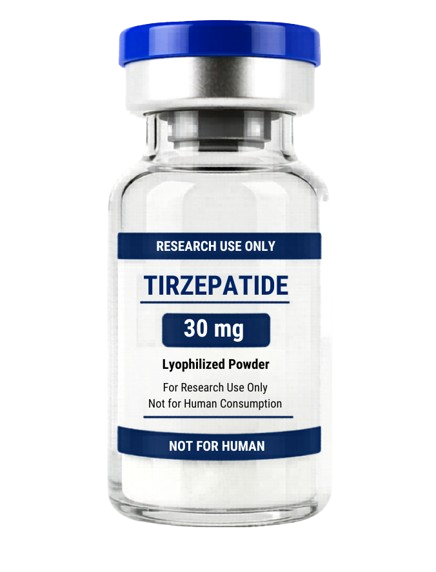
Torsena supplies research-grade tirzepatide to qualified laboratories across the European Union. Furthermore, we hold stock in Europe, so orders ship without intra-EU customs delay. Batch documentation is available on request.
Lot & Supply Format
- Purity. Typically ≥99%, and a batch-specific CoA is available on request.
- Formulation. Mannitol-free, so no bulking agents or buffer salts dilute the material.
- Presentation. Lyophilized peptide, sealed in glass research vials.
- Quantities. Single vials as standard, though we also quote bulk on request.
- Shipping. Dispatched from Europe, and always with temperature-appropriate packaging.
What is Tirzepatide (LY3298176)?
Tirzepatide is a synthetic 39-amino acid peptide built on the GIP sequence, and it acts as an agonist at two incretin receptors simultaneously. Eli Lilly developed it under the code LY3298176.
GIP receptor. This is the primary target, and the backbone comes from the native GIP sequence accordingly. Researchers examine nutrient-dependent insulin secretion, adipose tissue signaling, and bone metabolism pathways.
GLP-1 receptor. The second target. Here the focus falls on glucose-dependent insulin release, gastric motility, and central appetite signaling.
An important nuance on the balance between them. Tirzepatide is not a symmetric dual agonist. Its affinity at the GIP receptor sits close to that of native GIP, whereas its affinity at the GLP-1 receptor is lower than native GLP-1. Consequently the molecule is described as GIP-biased, and that asymmetry is the pharmacologically interesting feature rather than an imperfection. Therefore experimental designs comparing tirzepatide against a selective GLP-1 agonist should account for it.
Two structural modifications support the pharmacokinetic profile. A C20 fatty diacid attaches at Lys20 through a γGlu-miniPEG linker, and that promotes albumin binding. Separately, an Aib substitution at position 2 blocks the DPP-4 cleavage site that would otherwise degrade the peptide rapidly.
Tirzepatide received regulatory approval in the United States in May 2022 under the trade name Mounjaro. Material supplied here is for laboratory research only.
Supplied exclusively for in-vitro and ex-vivo research by qualified laboratories. Not intended for human or animal administration.
Receptor Data
Reported EC50 values for receptor internalisation:
| Receptor | Internalisation EC50 |
|---|---|
| GIP receptor (GIPR) | 18.2 nM |
| GLP-1 receptor (GLP-1R) | 18.1 nM |
Note that internalisation is a distinct endpoint from binding affinity or cAMP accumulation, and tirzepatide differentially induces internalisation at the two receptors. Therefore compare like with like when reading potency figures across papers, since the assay chosen changes the number substantially.
Mechanistic Overview
GIP axis. The GIP receptor is the primary target and the structural origin of the molecule. Researchers examine nutrient-dependent potentiation of insulin secretion, and also adipose tissue signaling, which is the mechanism usually proposed for the increased energy utilisation reported in metabolic models. Bone metabolism pathways feature as well, since GIP receptors are expressed there.
GLP-1 axis. Incretin research has characterised this receptor thoroughly, so it serves as a well-mapped reference point. Studies examine glucose-dependent insulin secretion, gastric motility, and central appetite pathways.
Dual receptor engagement. Because both receptors are expressed on pancreatic beta cells, a single molecule engaging both can produce responses that neither selective agonist reaches alone. Moreover, dual engagement recruits metabolically active tissue that selective GLP-1 agonists do not target, and adipose tissue is the usual example. Therefore tirzepatide serves as the reference tool for dual incretin work.
Research Applications
- Glycemic control models. Glucose tolerance testing, and likewise beta-cell function and insulin sensitivity endpoints.
- Body weight and energy expenditure. Diet-induced obesity models, particularly where energy utilisation is the measure.
- Adipose tissue signaling. GIP receptor expression makes this a distinctive application versus selective GLP-1 tools.
- Comparative incretin pharmacology. Single, dual and triple agonist comparisons, namely against semaglutide and retatrutide.
- Receptor trafficking. Internalisation and biased signaling studies, since the two receptors behave differently.
Published Research Data
Key references:
Coskun T, et al. LY3298176, a novel dual GIP and GLP-1 receptor agonist for the treatment of type 2 diabetes mellitus: from discovery to clinical proof of concept. Mol Metab. 2018;18:3-14.
Frías JP, et al. Tirzepatide versus semaglutide once weekly in patients with type 2 diabetes. N Engl J Med. 2021;385(6):503-515.
Rosenstock J, et al. Efficacy and safety of a novel dual GIP and GLP-1 receptor agonist tirzepatide in patients with type 2 diabetes (SURPASS-1). Lancet. 2021;398(10295):143-155.
Jastreboff AM, et al. Tirzepatide once weekly for the treatment of obesity. N Engl J Med. 2022;387(3):205-216.
Tirzepatide vs Semaglutide vs Retatrutide
| Characteristic | Tirzepatide | Semaglutide | Retatrutide |
|---|---|---|---|
| Receptor targets | Dual: GIP, GLP-1 | Single: GLP-1 | Triple: GIP, GLP-1, glucagon |
| Peptide backbone | GIP-based | GLP-1-based | GIP-based |
| Molecular length | 39 amino acids | 31 amino acids | 39 amino acids |
| Molecular weight | 4813.5 Da | 4113.58 Da | 4731.33 Da |
| Lipidation | C20 fatty diacid at Lys20 | C18 fatty diacid | Fatty diacid |
| Key distinction | GIP-biased dual agonism | Most characterised GLP-1 tool | Glucagon axis activity |
| Lilly code | LY3298176 | Not a Lilly compound | LY3437943 |
| CAS number | 2023788-19-2 | 910463-68-2 | 2381089-83-2 |
Notably tirzepatide and retatrutide share the same GIP backbone and the same 39-residue length. Therefore retatrutide is best understood as tirzepatide plus glucagon receptor activity rather than as an unrelated molecule.
Tirzepatide research peptide specifications
| Chemical name | Tirzepatide |
| Synonyms | LY3298176, LY-3298176 |
| CAS number | 2023788-19-2 (free base) |
| Molecular formula | C225H348N48O68 |
| Molecular weight | 4813.5 g/mol |
| PubChem CID | 156588324 |
| Peptide length | 39 amino acids |
| Backbone | GIP sequence |
| Lipidation | C20 fatty diacid at Lys20, via γGlu-miniPEG linker |
| Stability modification | Aib at position 2, blocking DPP-4 cleavage |
| Typical purity | ≥99% (HPLC / MS) |
| Physical form | White to off-white lyophilized powder |
| Additives | None, mannitol-free |
| Storage | -20°C, sealed, protected from light |
| Intended use | In-vitro / ex-vivo laboratory research only |
Note that batch molecular weight shifts slightly with hydration. Therefore work from the figure on your batch CoA when calculating solvent volumes.
Amino Acid Sequence
Tyr-Aib-Glu-Gly-Thr-Phe-Thr-Ser-Asp-Tyr-Ser-Ile-Ala-Leu-Asp-Lys-Ile-Ala-Gln-Lys*-Ala-Phe-Val-Gln-Trp-Leu-Ile-Ala-Gly-Gly-Pro-Ser-Ser-Gly-Ala-Pro-Pro-Pro-Ser
Modifications:
*Lys20 acylated with C20 fatty diacid (eicosanedioic acid) via γGlu-miniPEG linker
Aib = α-aminoisobutyric acid at position 2
Peptide length: 39 amino acids
Type: Linear, acylated
Note that the sequence contains lysine at both position 16 and position 20. Acylation occurs at Lys20, marked above, so take care when reading sequences elsewhere since the marker is frequently placed on the wrong residue.
Reconstitution & Storage
Acylated peptides behave differently from unmodified ones, and tirzepatide’s C20 fatty diacid tail makes it surface-active. Therefore handling needs more care than a short hydrophilic peptide.
- Low-binding tubes. Use them, since acylated peptides adsorb to standard polypropylene.
- Surfactants. Avoid unintended surfactant contact, because the lipid tail interacts with them.
- Storage vessel. Avoid prolonged storage in standard plastic where glass or low-binding alternatives exist.
- Short-term storage. 2-8°C for reconstituted aliquots.
- Long-term storage. Aliquot, then freeze at -20°C.
- Freeze-thaw. Avoid repeated cycles.
Keep lyophilized material at -20°C and protect it from light. Furthermore, let vials warm to room temperature before opening, because condensation otherwise pulls moisture into the powder. Otherwise follow your institutional SOPs for acylated peptides.
Analytical Documentation
We provide batch-specific Certificates of Analysis on request. Typically the documentation covers three areas.
- Purity. Determined by reverse-phase HPLC.
- Identity. Confirmed by mass spectrometry.
- Physical checks. Namely appearance and solubility verification.
Why Choose Torsena for Tirzepatide
- Documentation. We send batch CoAs on request, and they cover both HPLC purity and MS identity.
- No fillers. Mannitol-free, so nothing dilutes the material you paid for.
- EU distribution. We ship from European stock, and therefore intra-EU orders clear no customs.
- Direct contact. You reach the team directly, rather than a ticket queue.
Frequently Asked Questions
What is the molecular weight of tirzepatide?
Tirzepatide weighs 4813.5 g/mol with the formula C225H348N48O68, and it is catalogued as PubChem CID 156588324. However, batch values shift slightly with hydration, so use the figure on your CoA when calculating stock concentrations.
Is tirzepatide LY3298176 or LY3299176?
LY3298176. The Lilly compound code is frequently mistyped, and the wrong version circulates widely across vendor listings. Retatrutide, by contrast, is LY3437943.
Where is tirzepatide acylated?
At Lys20, through a γGlu-miniPEG linker carrying a C20 fatty diacid. Note that the sequence contains lysine at both position 16 and position 20, so acylation markers are often placed on the wrong residue in published sequence listings.
Is tirzepatide balanced between its two receptors?
No. Affinity at the GIP receptor sits close to native GIP, while affinity at the GLP-1 receptor is lower than native GLP-1, so the molecule is GIP-biased. Consequently experimental designs comparing it against a selective GLP-1 agonist should account for that asymmetry rather than treating the two arms as equivalent.
How does tirzepatide differ from retatrutide?
Both are 39-residue peptides on a GIP backbone, so they are structurally close relatives. Retatrutide adds glucagon receptor agonism on top of the GIP and GLP-1 activity tirzepatide already has. Therefore retatrutide is best understood as tirzepatide plus a third axis rather than as an unrelated compound.
Related Research Compounds
Researchers working on incretin pharmacology usually look at these as well.
- Retatrutide. The triple agonist on the same GIP backbone, and therefore the direct comparison for adding a glucagon arm.
- NAD+. A nucleotide coenzyme, particularly for the cellular metabolism side of metabolic research.
- SS-31. A mitochondria-targeted peptide, namely for energy metabolism and bioenergetics endpoints.
Otherwise, browse the full catalog at the Torsena shop.
Reviews
There are no reviews yet.