
Overview
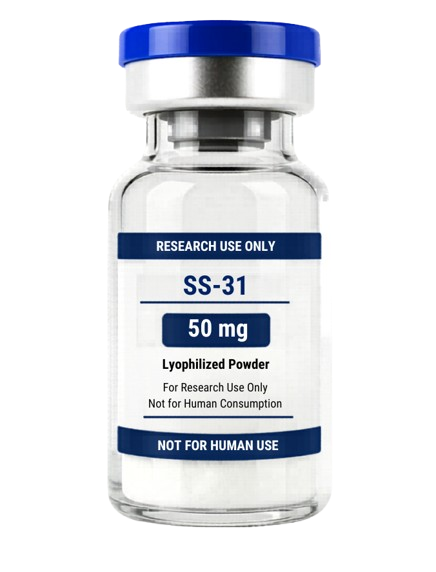
Torsena supplies SS-31 research peptide to qualified laboratories across the European Union. Currently shipping 50mg vials. Furthermore, we hold stock in Europe, so orders ship without intra-EU customs delay. Batch documentation is available on request.
Lot & Supply Format
- Purity. Typically ≥99%, and a batch-specific CoA is available on request.
- Formulation. No unnecessary bulking agents or buffer salts.
- Presentation. Lyophilized peptide, sealed in glass research vials.
- Quantities. 50mg vials, though we also quote bulk on enquiry.
- Shipping. Dispatched from Europe, and always with temperature-appropriate packaging.
What is SS-31 (Elamipretide)?
SS-31, also known as elamipretide, MTP-131 and Bendavia, is a synthetic cell-permeable tetrapeptide from the Szeto-Schiller peptide series. Its sequence is D-Arg-Dmt-Lys-Phe-NH2, built on an alternating aromatic-cationic motif.
That motif is the point of the molecule. Most compounds designed to reach mitochondria carry a lipophilic cation, typically triphenylphosphonium, which drives accumulation by exploiting membrane potential. SS-31 needs no such carrier. Instead the alternating aromatic and cationic residues let it cross membranes unaided, and it then concentrates at the inner mitochondrial membrane through selective cardiolipin affinity.
The uptake is more surprising than it sounds. SS-31 carries a formal charge of +3, and strongly charged molecules do not usually traverse plasma membranes at all. This one does, in a manner described as energy-independent and non-saturable, and it accumulates 1,000 to 5,000-fold at the inner mitochondrial membrane. Consequently the targeting works without any of the machinery comparable compounds require.
Regulatory status. Elamipretide received FDA accelerated approval in 2025 under the brand name Forzinity, as the hydrochloride salt, for Barth syndrome. It holds orphan drug designation from both the FDA and the EMA. Material supplied here is for laboratory research only.
Supplied exclusively for in-vitro and ex-vivo research by qualified laboratories. Not intended for human or animal administration.
Why a Four-Residue Peptide Survives
Short peptides are usually fragile, so the stability deserves explanation. Two of SS-31’s four residues are non-standard.
| Position | Residue | Type |
|---|---|---|
| 1 | D-Arg | D-enantiomer of arginine |
| 2 | Dmt | 2′,6′-dimethyltyrosine, non-proteinogenic |
| 3 | Lys | Standard L-amino acid |
| 4 | Phe-NH2 | Standard L-amino acid, C-terminally amidated |
Proteases recognise L-amino acid backbones, so half this molecule is effectively invisible to them. Moreover the C-terminal amidation removes the free carboxyl that carboxypeptidases would target. Therefore the stability is engineered rather than incidental, and the two aromatic rings, one of them dimethylated, also supply the aromatic half of the alternating motif that drives membrane permeability.
Mechanistic Overview
Cardiolipin binding. Cardiolipin is a phospholipid found almost exclusively in the inner mitochondrial membrane, concentrated in the cristae. SS-31 binds it selectively and reversibly. Notably this is both the targeting mechanism and the proposed mode of action, which is unusual, since most targeted compounds separate the two functions.
Cristae architecture. Cardiolipin is required for cristae membrane curvature and for assembly of respiratory chain supercomplexes. Research using SS-31 examines whether preserving cardiolipin interactions maintains cristae structure under conditions where it would otherwise be lost, and what that means for electron transport efficiency.
Cytochrome c peroxidase switching. Cytochrome c normally sits bound to cardiolipin as an electron carrier. However, when that interaction is disrupted, cytochrome c can switch to acting as a peroxidase, oxidising cardiolipin and starting a self-amplifying cycle of membrane damage. Therefore studies examine whether stabilising the cytochrome c and cardiolipin association interrupts that switch.
Bioenergetic endpoints. Reported measures include ATP synthesis rate, oxygen consumption, mitochondrial membrane potential, and mitochondrial reactive oxygen species production. These are the standard readouts for protocols using the compound.
Research Applications
- Mitochondrial bioenergetics. Oxygen consumption and ATP synthesis, and likewise membrane potential measurement.
- Ischemia-reperfusion models. Cardiac and renal, particularly where mitochondrial recovery is the endpoint.
- Cristae ultrastructure. Electron microscopy work, namely on supercomplex assembly.
- Oxidative stress. ROS production and lipid peroxidation endpoints.
- Neuroinflammation. Published work covers LPS-induced mitochondrial dysfunction models.
- Fibrosis models. Studies report NLRP3 inflammasome effects in macrophage work.
Published Research Data
Key references:
Birk AV, et al. The mitochondrial-targeted compound SS-31 re-energizes ischemic mitochondria by interacting with cardiolipin. J Am Soc Nephrol. 2013;24(8):1250-1261.
Szeto HH. First-in-class cardiolipin-protective compound as a therapeutic agent to restore mitochondrial bioenergetics. Br J Pharmacol. 2014;171(8):2029-2050.
Zhao W, et al. Elamipretide (SS-31) improves mitochondrial dysfunction, synaptic and memory impairment induced by lipopolysaccharide in mice. J Neuroinflammation. 2019;16:230.
Nie Y, et al. Elamipretide (SS-31) attenuates idiopathic pulmonary fibrosis by inhibiting the Nrf2-dependent NLRP3 inflammasome in macrophages. Antioxidants. 2023;12(12):2022.
SS-31 vs Other Mitochondrial Research Compounds
| Characteristic | SS-31 | MOTS-c | MitoQ |
|---|---|---|---|
| Compound class | Mitochondria-targeted peptide | Mitochondrial-derived peptide | Small molecule conjugate |
| Origin | Synthetic tetrapeptide | Encoded in mitochondrial DNA | Ubiquinone plus targeting cation |
| Targeting mechanism | Cardiolipin affinity | Endogenous signalling peptide | Triphenylphosphonium cation |
| Molecular weight | 639.80 Da | 2174.62 Da | Not a peptide |
| Length | 4 amino acids | 16 amino acids | Not a peptide |
| Primary research focus | Cristae integrity, electron transport | Metabolic and exercise signalling | Mitochondrial antioxidant capacity |
The distinction in the first row is the one worth understanding. Mitochondria-targeted means a synthetic compound accumulates there. Mitochondrial-derived means the mitochondrial genome encodes it. Secondary sources conflate the two constantly, though they describe entirely different things.
SS-31 research peptide specifications
| Chemical name | SS-31 |
| Synonyms | Elamipretide, MTP-131, Bendavia |
| CAS number | 736992-21-5 (free base) |
| CAS, hydrochloride | 72244098-12-0 |
| Molecular formula | C32H49N9O5 |
| Molecular weight | 639.80 g/mol (free base) |
| PubChem CID | 11764719 |
| Sequence | D-Arg-Dmt-Lys-Phe-NH2 |
| Peptide length | 4 amino acids |
| Non-standard residues | D-Arg, Dmt |
| Formal charge | +3 |
| C-terminus | Amidated |
| Typical purity | ≥99% (HPLC / MS) |
| Physical form | White to off-white lyophilized powder |
| Available sizes | 50mg |
| Storage | -20°C, sealed, protected from light |
| Intended use | In-vitro / ex-vivo laboratory research only |
Note that SS-31 ships in different salt forms across suppliers, commonly acetate, trifluoroacetate or hydrochloride. The salt changes the molecular weight, so calculate molarity from the figure on your batch CoA rather than from the free base value.
Structure
D-Arg-Dmt-Lys-Phe-NH2
Residues:
D-Arg = D-arginine
Dmt = 2′,6′-dimethyltyrosine
Lys = L-lysine
Phe = L-phenylalanine
C-terminus: Amidated
Motif: Alternating aromatic-cationic
Type: Linear tetrapeptide
Note: No cysteine or methionine, therefore no sulfur in the formula.
Reconstitution & Storage
- Solvent. Sterile water or a suitable aqueous buffer, since the +3 charge makes it readily water-soluble.
- Short-term storage. 2-8°C for reconstituted aliquots.
- Long-term storage. Aliquot, then freeze at -20°C.
- Freeze-thaw. Minimise cycles.
- Molarity. Work from the CoA mass, since the salt form shifts it.
Keep lyophilized material at -20°C and protect it from light. Furthermore, let vials warm to room temperature before opening, because condensation otherwise pulls moisture into the powder. Note that no methionine or cysteine is present, so inert-atmosphere handling is unnecessary here. Otherwise follow your institutional SOPs.
Analytical Documentation
Batch-specific Certificates of Analysis are available on request for institutional procurement. Typically the documentation covers three areas.
- Purity. Determined by reverse-phase HPLC.
- Identity. Confirmed by mass spectrometry.
- Physical checks. Namely appearance and solubility verification.
Why Choose Torsena for SS-31 Research Peptide
- Documentation. We send batch CoAs on request, and they cover both HPLC purity and MS identity.
- Clean formulation. No unnecessary bulking agents or buffer salts.
- EU distribution. We ship from European stock, and therefore intra-EU orders clear no customs.
- Direct contact. You reach the team directly, rather than a ticket queue.
Frequently Asked Questions
What is the molecular weight of SS-31?
The free base is 639.80 g/mol with the formula C32H49N9O5, CAS 736992-21-5, PubChem CID 11764719. However, SS-31 ships in various salt forms and the salt shifts the mass, so calculate molarity from your batch CoA figure rather than the free base value.
How does SS-31 reach mitochondria without a targeting cation?
Through its alternating aromatic-cationic motif. Despite carrying a formal charge of +3, which would normally prevent membrane crossing entirely, SS-31 traverses the plasma membrane in an energy-independent and non-saturable manner, then accumulates 1,000 to 5,000-fold at the inner mitochondrial membrane through cardiolipin affinity. Consequently it needs none of the triphenylphosphonium machinery that comparable compounds rely on.
Why is such a short peptide stable?
Because half of it is not made of standard residues. D-Arg is a D-enantiomer and Dmt is 2′,6′-dimethyltyrosine, which is non-proteinogenic, so proteases recognising L-amino acid backbones have little to cleave. The C-terminal amidation also removes the carboxypeptidase target.
What is the difference between SS-31 and MOTS-c?
They sound similar and are not. SS-31 is a synthetic tetrapeptide that accumulates at mitochondria, making it mitochondria-targeted. MOTS-c is a 16-residue peptide encoded by the mitochondrial genome that signals outward to the nucleus, making it mitochondrial-derived. Therefore one is structural and the other is a signalling molecule.
Is elamipretide approved for clinical use?
Yes, in the US. The FDA granted accelerated approval in 2025 to Forzinity, elamipretide hydrochloride, for improving muscle strength in patients with Barth syndrome, and it holds orphan drug designation from both the FDA and EMA. It remains prescription-only. Torsena supplies SS-31 strictly for in-vitro and ex-vivo laboratory research, never for human or animal administration.
Related Research Compounds
Researchers working on mitochondrial function usually look at these as well.
- MOTS-c. A mitochondrial-derived peptide, and therefore the direct mechanistic contrast to a mitochondria-targeted one.
- NAD+ Buffered. A cofactor central to mitochondrial redox and cellular metabolism research.
- GHK-Cu. A copper peptide, namely for regenerative and tissue endpoints.
Otherwise, browse the full catalog at the Torsena shop.