

Overview
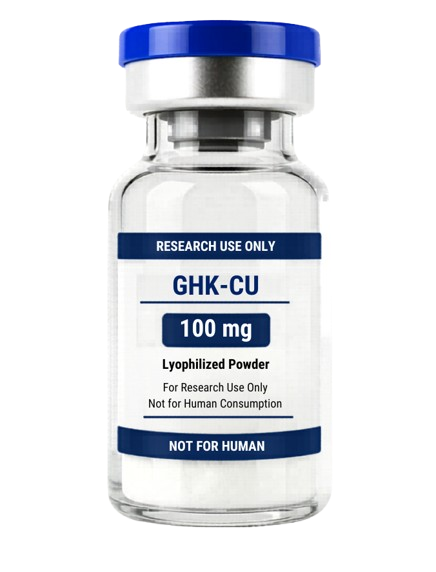
Torsena is a European supplier of research-grade GHK-Cu dedicated to qualified laboratories and research institutions. Orders ship from EU-based stock with batch documentation available upon request. Single vials and bulk quantities are available for ongoing study protocols.
Lot & Supply Format
- Purity ≥99% verified by HPLC/MS analysis
- Mannitol-free formulation (no bulking agents or buffers)
- Lyophilized peptide-copper complex in sealed glass research vials
- Single vials and bulk quantities available
- CoA transparency: batch-specific certificate of analysis available upon request
- Shipped from Europe with temperature-appropriate packaging
What is GHK-Cu?
GHK-Cu (glycyl-L-histidyl-L-lysine copper complex) is a naturally occurring copper-binding tripeptide. It was first identified in human plasma by Loren Pickart in 1973. The GHK sequence binds copper(II) ions with high affinity. Coordination occurs through the histidine imidazole nitrogen, the glycine amino terminus, and the deprotonated amide nitrogen. The result is a well-characterized 1:1 peptide-copper complex.
GHK-Cu is one of the most extensively studied peptide-metal complexes in regenerative and extracellular matrix research. It has over five decades of published literature behind it. Its natural occurrence in human plasma declines with age in physiological studies. Its broad gene-modulating activity profile in transcriptomic research has made it a widely referenced compound across dermatological, regenerative, and aging-related research fields.
Supplied exclusively for in-vitro and ex-vivo research by qualified laboratories. Not intended for human or animal administration.
Mechanistic Overview
Extracellular Matrix Signaling
GHK-Cu has been studied extensively in models examining collagen synthesis, decorin expression, and glycosaminoglycan production pathways. Published research describes upregulation of collagen I, collagen III, and elastin expression in fibroblast culture models. This positions the compound as a tool for investigating extracellular matrix remodeling signaling.
Gene Expression Modulation
Broad transcriptomic analyses using Illumina microarray studies have characterized GHK-Cu as modulating the expression of approximately 4,000 human genes. This represents roughly 6% of the human genome. Published findings describe effects on genes associated with antioxidant response (Nrf2 pathway), DNA repair mechanisms, ubiquitin-proteasome pathway components, and inflammatory signaling cascades.
Copper Delivery
The GHK tripeptide serves as a bioavailable copper delivery vehicle. The copper(II) ion participates in metalloenzyme cofactor functions, including lysyl oxidase (required for collagen cross-linking) and superoxide dismutase (SOD). Research has examined the relative contributions of the peptide sequence versus the copper ion to observed biological effects. These contributions have been characterized in separation and reconstitution experiments.
Angiogenesis Research
Preclinical models have examined GHK-Cu in the context of vascular formation signaling, VEGF expression modulation, and endothelial cell migration assays. These studies position the compound as a research tool for investigating the relationship between copper-peptide complexes and angiogenic pathway activation.
Reconstitution & Storage
Lyophilized GHK-Cu is stable at -20°C for long-term storage. Reconstitution for in-vitro work is typically performed using bacteriostatic water or sterile saline. The reconstituted solution displays a characteristic blue color reflecting the copper(II) coordination — this is expected for the formulation. Reconstituted aliquots are generally stored at 2-8°C for short-term use. For extended storage, aliquot and freeze at -20°C to preserve peptide integrity. Avoid prolonged exposure to alkaline conditions, which can disrupt the copper coordination. Researchers should follow institutional SOPs for handling lyophilized peptides.
Why Torsena
- Analytical Testing — Purity verified by third-party HPLC and mass spectrometry
- No Fillers — Mannitol-free, no bulking agents or buffer salts
- Batch Transparency — Certificate of Analysis available upon request
- Consistent Availability — Single vials and bulk quantities maintained in stock
- EU Distribution — Shipped from European fulfillment with tracked courier
- Full Documentation — Batch-specific CoA and MSDS available for institutional procurement
Product Specifications
Chemical Name: GHK-Cu (Glycyl-L-histidyl-L-lysine Copper(II) Complex)
Synonyms: Copper peptide, Cu-GHK, Copper tripeptide-1
CAS Number: 49557-75-7
Molecular Formula: C₁₄H₂₃CuN₆O₄
Molecular Weight: 403.92 g/mol
Purity: ≥99% (HPLC/MS)
Physical Form: Blue lyophilized powder
Additives: None (mannitol-free)
Intended Use: In-vitro / ex-vivo laboratory research only
Amino Acid Sequence
Gly-His-Lys · Cu²⁺
Metal Coordination: Copper(II) bound via histidine imidazole nitrogen, glycine amino terminus, and deprotonated amide nitrogen
Peptide Length: 3 amino acids
Type: Linear tripeptide-metal complex
Analytical Transparency
All Torsena research materials are tested for purity and identity by HPLC and mass spectrometry analysis. Batch-specific Certificates of Analysis are available upon request for institutional procurement.
- Reverse-phase HPLC purity determination
- Mass spectrometry identity confirmation
- Copper content verification (ICP-MS or AAS)
- Appearance and solubility verification
- Endotoxin screening (where applicable)
Related Research Compounds
Researchers studying regenerative signaling, extracellular matrix biology, and longevity pathways may also be interested in:
Reviews
There are no reviews yet.