

Overview
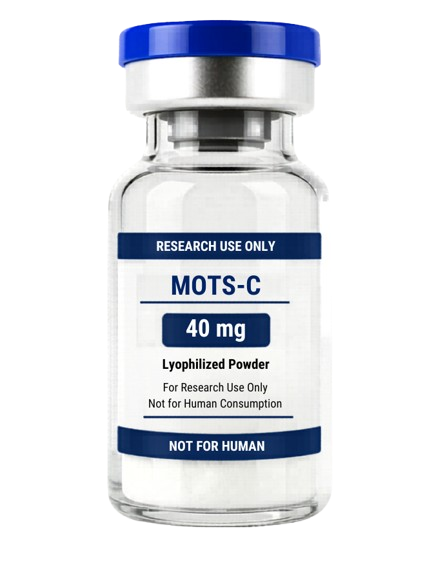
Torsena is a European supplier of research-grade MOTS-c dedicated to serving qualified laboratories and research institutions. Orders are shipped from EU-based stock with batch documentation available upon request. Single vials and bulk quantities are available for ongoing study protocols.
Lot & Supply Format
- Purity ≥99% verified by HPLC/MS analysis
- Mannitol-free formulation (no bulking agents or buffers)
- Lyophilized peptide in sealed glass research vials
- Single vials and bulk quantities available
- CoA transparency: batch-specific certificate of analysis available upon request
- Shipped from Europe with temperature-appropriate packaging
What is MOTS-c?
MOTS-c is a 16-amino acid mitochondrial-derived peptide (MDP) encoded by the mitochondrial 12S rRNA gene (MT-RNR1). It was first identified and characterized by Changhan Lee and colleagues at the University of Southern California in 2015, representing a novel class of bioactive peptides originating from the mitochondrial genome rather than the nuclear genome.
MOTS-c is one of several known mitochondrial-derived peptides — including humanin and the SHLP1-6 family — that function as retrograde signaling molecules. These peptides are produced by mitochondria and influence nuclear gene expression and systemic metabolic regulation. This positions MOTS-c as a research tool for investigating mito-nuclear communication pathways.
Research interest in MOTS-c has expanded since its discovery, driven in part by experimental observations that its circulating levels decline with age in animal models, paralleling age-related changes in metabolic function and exercise capacity.
Supplied exclusively for in-vitro and ex-vivo research by qualified laboratories. Not intended for human or animal administration.
Mechanistic Overview
AMPK Activation via Folate Cycle Inhibition
MOTS-c has been characterized in experimental models as an activator of AMP-activated protein kinase (AMPK), a master regulator of cellular energy homeostasis. The proposed mechanism involves inhibition of the folate cycle enzyme MTHFD2 (methylenetetrahydrofolate dehydrogenase 2), which disrupts de novo purine biosynthesis. This disruption causes accumulation of the upstream metabolite AICAR (5-aminoimidazole-4-carboxamide ribonucleotide), a known direct AMPK activator. The folate-AICAR-AMPK axis represents the primary mechanistic framework for MOTS-c metabolic signaling.
Nuclear Translocation
Under metabolic stress conditions in experimental models, MOTS-c has been observed to translocate from mitochondria to the nucleus, where it interacts with nuclear DNA and modulates gene expression related to antioxidant response elements (ARE) and the NRF2 pathway. This nuclear translocation represents a direct mito-nuclear communication mechanism.
Exercise Mimetic Research
Preclinical studies have examined MOTS-c in the context of exercise-related metabolic signaling, describing AMPK-dependent metabolic adaptations in skeletal muscle models that parallel those observed with physical activity. These findings have positioned MOTS-c as a research tool for investigating the molecular mechanisms underlying exercise-induced metabolic benefits.
MOTS-c vs NAD+
| Characteristic | MOTS-c | NAD+ |
|---|---|---|
| Classification | Mitochondrial-derived peptide | Nucleotide coenzyme |
| Origin | Mitochondrial 12S rRNA gene | Biosynthetic (tryptophan/salvage pathways) |
| Primary Target | AMPK / folate cycle | Sirtuins / PARPs / CD38 |
| Mitochondrial Role | Retrograde signaling molecule | Electron transport cofactor |
| Research Focus | Exercise mimetics, mito-nuclear communication | Redox metabolism, aging, DNA repair |
| CAS Number | 1627580-64-6 | 53-84-9 |
For comparative metabolic and longevity research, see also our NAD+ research compound.
Reconstitution & Storage
Lyophilized MOTS-c is stable at -20°C for long-term storage. Reconstitution for in-vitro work is typically performed using bacteriostatic water or sterile saline; reconstituted aliquots are generally stored at 2-8°C for short-term use or -20°C for extended storage to preserve peptide integrity. Researchers should follow institutional SOPs for handling lyophilized peptides.
Why Torsena
- Analytical Testing — Purity verified by third-party HPLC and mass spectrometry
- No Fillers — Mannitol-free, no bulking agents or buffer salts
- Batch Transparency — Certificate of Analysis available upon request
- Consistent Availability — Single vials and bulk quantities maintained in stock
- EU Distribution — Shipped from European fulfillment with tracked courier
- Full Documentation — Batch-specific CoA and MSDS available for institutional procurement
Product Specifications
Chemical Name: MOTS-c (Mitochondrial ORF of the 12S rRNA type-c)
Synonyms: MOTS-c peptide, Mitochondrial-Derived Peptide MOTS-c
CAS Number: 1627580-64-6
Molecular Formula: C₁₀₁H₁₅₂N₂₈O₂₃S₂
Molecular Weight: 2174.56 g/mol
Purity: ≥99% (HPLC/MS)
Physical Form: White lyophilized powder
Additives: None (mannitol-free)
Intended Use: In-vitro / ex-vivo laboratory research only
Amino Acid Sequence
Met-Arg-Trp-Gln-Glu-Met-Gly-Tyr-Ile-Phe-Tyr-Pro-Arg-Lys-Leu-Arg
Peptide Length: 16 amino acids
Type: Linear, unmodified
Genomic Origin: Mitochondrial 12S rRNA gene (MT-RNR1)
Analytical Transparency
All Torsena research materials are tested for purity and identity by HPLC and mass spectrometry analysis. Batch-specific Certificates of Analysis are available upon request for institutional procurement.
- Reverse-phase HPLC purity determination
- Mass spectrometry identity confirmation
- Appearance and solubility verification
- Endotoxin screening (where applicable)
Related Research Compounds
Researchers studying mitochondrial function, cellular energy metabolism, and longevity pathways may also be interested in:

Reviews
There are no reviews yet.