

Overview
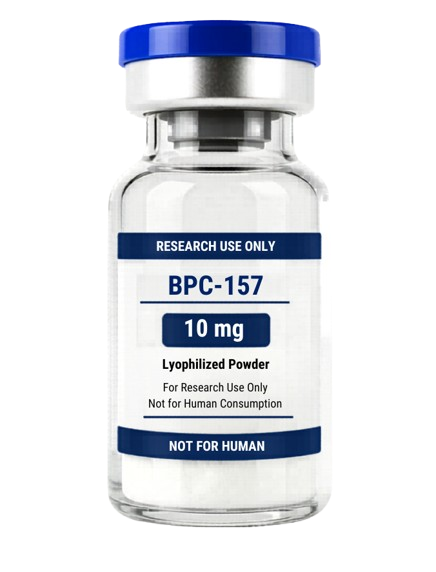
Torsena supplies research-grade BPC-157 to qualified laboratories across the European Union. Furthermore, we hold stock in Europe, so orders ship without intra-EU customs delay. Batch documentation is available on request.
Lot & Supply Format
- Purity. Typically ≥99%, and a batch-specific CoA is available on request.
- Formulation. Mannitol-free, so no bulking agents or buffer salts dilute the material.
- Presentation. Lyophilized peptide, sealed in glass research vials.
- Quantities. Single vials as standard, though we also quote bulk on request.
- Shipping. Dispatched from Europe, and always with temperature-appropriate packaging.
What is BPC-157?
BPC-157, or Body Protection Compound 157, is a synthetic pentadecapeptide of fifteen amino acids. Its sequence corresponds to a partial fragment of a protein found in human gastric juice. Sikirić, Seiwerth and colleagues at the University of Zagreb first characterised it in the early 1990s.
Unusually for a peptide of this size, BPC-157 shows stability in acidic and enzymatic conditions, and that property is what drew initial attention in gastrointestinal models. However, note that stability in gastric juice is a separate matter from stability in solution once reconstituted, so standard peptide handling still applies at the bench.
Plasma half-life is under 30 minutes, which is short. Consequently protocols examining sustained effects generally use repeat dosing rather than single administration, and this is worth accounting for before designing a time-course experiment.
BPC-157 derives from no approved pharmaceutical product and holds no marketing authorisation anywhere. It remains a research compound studied in preclinical settings.
Supplied exclusively for in-vitro and ex-vivo research by qualified laboratories. Not intended for human or animal administration.
A Note on the Evidence Base
Anyone evaluating BPC-157 should understand how its literature is distributed, since this affects how the findings should be weighted.
The overwhelming majority of published BPC-157 studies originate from a single research group centred on Sikirić at the University of Zagreb. A 2025 systematic review by Vasireddi and colleagues in HSS Journal documented this concentration explicitly, synthesising 36 studies published between 1993 and June 2024. Of those, 35 were preclinical animal studies and one was an uncontrolled human chart review. Therefore no completed controlled human efficacy trial exists.
Independent replication is limited but not absent. Notably it includes the Hsieh VEGFR2 work from 2017, the Chang FAK-paxillin tendon study from 2011 with its 2014 growth hormone receptor follow-up, a 2019 systematic review by Gwyer, Wragg and Wilson in Cell and Tissue Research, and a 2019 enteric neuron paper by Wang, Qu and Duan in Neuroscience Bulletin.
Consequently BPC-157 is best treated as a tool for investigating tissue repair pathways in animal and in-vitro models rather than as a compound with an established mechanism. Researchers planning work should weight single-group findings accordingly.
Mechanistic Overview
Angiogenic signaling through VEGFR2. This is the best-characterised mechanism, and it is one of the few with independent replication behind it. Preclinical work links BPC-157 to VEGFR2 receptor activation and downstream Akt and eNOS signaling. Therefore studies commonly use vascular formation endpoints in tissue injury models.
Nitric oxide through a VEGF-independent route. More interesting mechanistically than the VEGFR2 pathway alone, because it runs separately. BPC-157 activates Src kinase, Src then acts on caveolin-1, and that step releases endothelial nitric oxide synthase from its inhibitory binding. One study reports roughly a 50% reduction in eNOS-caveolin-1 binding. Consequently BPC-157 engages the nitric oxide system through two distinct routes rather than one.
Cell migration through FAK-paxillin. Focal adhesion kinase and paxillin govern fibroblast attachment and movement. Chang and colleagues characterised this in tendon fibroblasts in 2011, and it is one of the independently replicated findings. Moreover, follow-up work reported increased growth hormone receptor levels in the same cell type.
ERK1/2 signaling. Studies also describe ERK1/2 involvement, particularly in endothelial tube formation assays.
Gene expression. In a rat stroke model, BPC-157 increased expression of Egr1, Akt1, Kras, Src, Foxo, Srf, Vegfr2, Nos3 and Nos1, while decreasing Nos2 and Nfkb. Therefore transcriptomic endpoints appear alongside pathway-specific ones in much of the literature.
Research Applications
- Gastrointestinal models. Gastric protection is the most repeated finding since 1993, namely against NSAID, alcohol, stress and ischemia-reperfusion challenge.
- Tendon and ligament repair. Wistar rat models predominate, particularly Achilles, patellar, and tendon-to-bone attachment.
- Angiogenesis assays. Endothelial tube formation, and likewise vascular network endpoints in injury models.
- Nitric oxide system. eNOS activity and caveolin-1 binding, since the Src route is distinctive.
- Cell migration. Fibroblast outgrowth and attachment, especially using FAK-paxillin readouts.
Published rodent protocols commonly dose between 10 ng/kg and 10 µg/kg. However, dosing varies considerably by model and endpoint, so consult primary sources directly.
Published Research Data
Key references:
Chang CH, et al. The promoting effect of pentadecapeptide BPC 157 on tendon healing involves tendon outgrowth, cell survival, and cell migration. J Appl Physiol. 2011;110(3):774-780.
Hsieh MJ, et al. Therapeutic potential of pro-angiogenic BPC157 is associated with VEGFR2 activation and up-regulation. J Mol Med. 2017.
Gwyer D, Wragg NM, Wilson SL. Gastric pentadecapeptide body protection compound BPC 157 and its role in accelerating musculoskeletal soft tissue healing. Cell Tissue Res. 2019.
Seiwerth S, et al. Stable gastric pentadecapeptide BPC 157 and wound healing. Front Pharmacol. 2021;12:627533.
Vasireddi N, et al. Systematic review of BPC-157. HSS J. 2025.
BPC-157 research peptide specifications
| Chemical name | BPC-157, pentadecapeptide BPC 157 |
| Synonyms | Body Protection Compound 157, PL 14736, PL-10, Bepecin |
| CAS number | 137525-51-0 |
| Molecular formula | C62H98N16O22 |
| Molecular weight | 1419.53 g/mol |
| Sequence | Gly-Glu-Pro-Pro-Pro-Gly-Lys-Pro-Ala-Asp-Asp-Ala-Gly-Leu-Val |
| One-letter code | GEPPPGKPADDAGLV |
| Peptide length | 15 amino acids |
| Type | Linear, unmodified |
| Origin | Partial sequence of a human gastric juice protein |
| Plasma half-life | Under 30 minutes |
| Typical purity | ≥99% (HPLC / MS) |
| Physical form | White lyophilized powder |
| Additives | None, mannitol-free |
| Storage | -20°C, sealed, protected from light |
| Intended use | In-vitro / ex-vivo laboratory research only |
Because the sequence carries no cysteine and no methionine, the formula contains no sulfur, and the theoretical mass is unambiguous. Therefore mass spectrometry confirms identity cleanly against a CoA.
Reconstitution & Storage
- Solvent. Sterile water or a suitable aqueous buffer.
- Short-term storage. 2-8°C for reconstituted aliquots.
- Long-term storage. Aliquot, then freeze at -20°C.
- Freeze-thaw. Avoid repeated cycles, since each one costs integrity.
Keep lyophilized material at -20°C and protect it from light. Furthermore, let vials warm to room temperature before opening, because condensation otherwise pulls moisture into the powder. Note also that the compound’s documented stability in gastric juice does not transfer to reconstituted storage conditions, so standard peptide practice still applies. Otherwise follow your institutional SOPs.
Analytical Documentation
We provide batch-specific Certificates of Analysis on request. Typically the documentation covers three areas.
- Purity. Determined by reverse-phase HPLC.
- Identity. Confirmed by mass spectrometry.
- Physical checks. Namely appearance and solubility verification.
Why Choose Torsena for BPC-157
- Documentation. We send batch CoAs on request, and they cover both HPLC purity and MS identity.
- No fillers. Mannitol-free, so nothing dilutes the material you paid for.
- EU distribution. We ship from European stock, and therefore intra-EU orders clear no customs.
- Direct contact. You reach the team directly, rather than a ticket queue.
Frequently Asked Questions
What is the molecular weight of BPC-157?
BPC-157 weighs 1419.53 g/mol with the formula C62H98N16O22, and the sequence is GEPPPGKPADDAGLV. Because it contains no cysteine or methionine, the formula carries no sulfur and the theoretical mass is unambiguous, so mass spectrometry verifies identity cleanly.
What is the half-life of BPC-157?
Under 30 minutes in plasma. Consequently protocols examining sustained effects generally rely on repeat dosing rather than single administration, and time-course designs should account for the short window.
How strong is the evidence base for BPC-157?
Extensive in volume but concentrated in source. A 2025 systematic review found 36 studies published between 1993 and June 2024, of which 35 were preclinical animal work and one was an uncontrolled human chart review, with no completed controlled human efficacy trial. Moreover, the majority originate from a single group at the University of Zagreb. Independent replications exist, notably the 2017 VEGFR2 work and the 2011 FAK-paxillin tendon study, but they remain limited.
How does BPC-157 affect nitric oxide?
Through two distinct routes. One runs via VEGFR2 and downstream Akt-eNOS signaling. The other is VEGF-independent: BPC-157 activates Src kinase, Src acts on caveolin-1, and that releases eNOS from inhibitory binding, with one study reporting roughly a 50% reduction in eNOS-caveolin-1 association.
What is the regulatory status of BPC-157?
It holds no marketing authorisation in any country. WADA has listed it under class S0, non-approved substances, since January 2022, prohibited at all times with no therapeutic use exemption available. The FDA classifies it as a Category 2 bulk drug substance, which excludes it from compounding. Torsena supplies it strictly for in-vitro and ex-vivo laboratory research, never for human or animal administration.
Related Research Compounds
Researchers working on tissue repair signaling usually look at these as well.
- GHK-Cu. A copper tripeptide, and therefore a complementary tool for extracellular matrix and gene expression endpoints.
- Klow80. A four-component preparation containing BPC-157, namely where a protocol examines several repair pathways together.
Otherwise, browse the full catalog at the Torsena shop.
Reviews
There are no reviews yet.