
Overview
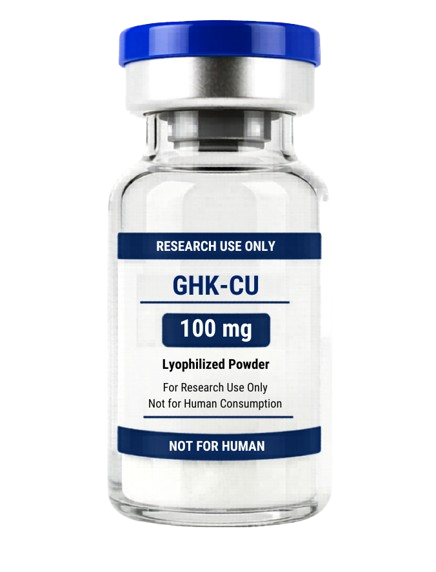
Torsena supplies research-grade GHK-Cu to qualified laboratories across the European Union. Furthermore, we hold stock in Europe, so orders ship without intra-EU customs delay. Batch documentation is available on request.
Lot & Supply Format
- Purity. Typically ≥99%, and a batch-specific CoA is available on request.
- Formulation. Mannitol-free, so no bulking agents or buffer salts dilute the material.
- Presentation. Lyophilized peptide-copper complex, sealed in glass research vials.
- Quantities. Single vials as standard, though we also quote bulk on request.
- Shipping. Dispatched from Europe, and always with temperature-appropriate packaging.
What is GHK-Cu?
GHK-Cu is the copper(II) complex of the naturally occurring tripeptide glycyl-L-histidyl-L-lysine. Loren Pickart and Marcia Thaler first isolated it from human plasma in 1973, while investigating a factor that made aged liver tissue synthesise protein like younger tissue.
The GHK sequence binds copper(II) with high affinity in a 1:1 complex. Specifically, coordination occurs through the histidine imidazole nitrogen, the glycine amino terminus, and a deprotonated amide nitrogen. Consequently the copper sits in a roughly planar arrangement, and it functions as part of the molecule rather than as an additive.
Notably the sequence is not synthetic in origin. It occurs within the alpha-2 chain of type I collagen, and it circulates in plasma at concentrations that fall with age: roughly 200 ng/mL at age 20 against roughly 80 ng/mL by age 60. That decline is the observation behind most of the research interest, since it raises the question of whether restoring GHK locally restores the repair signaling that falls alongside it.
Supplied exclusively for in-vitro and ex-vivo research by qualified laboratories. Not intended for human or animal administration.
GHK versus GHK-Cu: Why the Form Matters
These are two distinct entities and the literature conflates them constantly. Therefore anyone comparing published studies needs to check which form each used.
| Property | GHK (free peptide) | GHK-Cu (copper complex) |
|---|---|---|
| CAS number | 49557-75-7 | 89030-95-5 |
| Molecular formula | C14H24N6O4 | C14H22CuN6O4 |
| Molecular weight | 340.38 | ~402 (see note) |
| Copper present | No | Yes, 1:1 |
| Appearance | White powder | Blue powder |
| Copper-dependent activity | Requires added Cu(II) | Pre-formed |
Because copper coordination underpins most documented matrix-remodeling activity, substituting one form for the other changes the experiment. This product is the pre-formed complex.
A note on the molecular weight. You will find 401.9, 402.92 and 403.93 quoted for GHK-Cu across suppliers and databases. The difference comes from whether the figure accounts for the two protons displaced when copper coordinates. Free GHK weighs 340.38, so adding copper’s atomic mass alone gives 403.93, whereas subtracting the two displaced protons first gives roughly 401.9. Therefore treat the figure as approximate and work from the value on your batch CoA when calculating molarity.
Mechanistic Overview
Extracellular matrix signaling. Studies in fibroblast culture describe upregulation of collagen I, collagen III, and elastin expression, alongside effects on decorin and glycosaminoglycan production. Consequently GHK-Cu features heavily in work on matrix remodeling, and it also modulates matrix metalloproteinase expression, which is the counterpart process to synthesis.
Copper delivery and metalloenzyme function. The tripeptide acts as a bioavailable carrier, and the copper it delivers serves as a cofactor for copper-dependent enzymes. Lysyl oxidase is the relevant one for matrix work, since it performs collagen cross-linking, while superoxide dismutase is relevant to antioxidant endpoints. Therefore separation and reconstitution experiments, which compare the free peptide against the complex, are the standard approach for attributing an effect to the peptide or to the metal.
Gene expression. Pickart and colleagues have reported broad transcriptomic effects, concentrated in tissue-repair, antioxidant and anti-inflammatory pathway genes. Described pathways include Nrf2-associated antioxidant response, DNA repair, ubiquitin-proteasome components, and inflammatory signaling. Note that the frequently quoted figure of roughly 4,000 genes is an extrapolation from Connectivity Map analysis rather than a direct count, so it is worth citing as such.
Angiogenesis. Preclinical models have examined vascular formation signaling, VEGF expression, and endothelial migration. Therefore the compound appears in work on the relationship between copper-peptide complexes and angiogenic activation.
Published Research Data
Key references:
Pickart L, Thaler MM. Tripeptide in human serum which prolongs survival of normal liver cells and stimulates growth in neoplastic liver. Nat New Biol. 1973;243(124):85-87.
Pickart L, Vasquez-Soltero JM, Margolina A. GHK peptide as a natural modulator of multiple cellular pathways in skin regeneration. Biomed Res Int. 2015.
Pickart L, Margolina A. Regenerative and protective actions of the GHK-Cu peptide in the light of the new gene data. Int J Mol Sci. 2018;19(7):1987.
Reconstitution & Storage
GHK-Cu dissolves readily in aqueous solution, so reconstitution is straightforward. However, the copper centre introduces two constraints the rest of our range does not have.
- Solvent. Sterile water or a suitable aqueous buffer.
- Alkaline conditions. Avoid prolonged exposure, since high pH disrupts copper coordination.
- Reducing agents. Avoid them, because they act on the copper(II) centre directly.
- Blue colour. Expected. It reflects copper(II) coordination and is not a sign of contamination.
- Short-term storage. 2-8°C for reconstituted aliquots.
- Long-term storage. Aliquot, then freeze at -20°C.
Keep lyophilized material at -20°C and protect it from light. Furthermore, let vials warm to room temperature before opening, because condensation otherwise pulls moisture into the powder. Otherwise follow your institutional SOPs.
GHK-Cu research compound specifications
| Chemical name | Glycyl-L-histidyl-L-lysine copper(II) complex |
| Synonyms | Copper peptide, Cu-GHK, Copper tripeptide-1 |
| CAS number | 89030-95-5 (copper complex) |
| Free peptide CAS | 49557-75-7 (GHK, for reference) |
| Molecular formula | C14H22CuN6O4 |
| Molecular weight | ~402 g/mol (see note above) |
| Sequence | Gly-His-Lys · Cu(II) |
| Peptide length | 3 amino acids |
| Stoichiometry | 1:1 peptide to copper |
| Coordination | Histidine imidazole N, glycine amino terminus, deprotonated amide N |
| Typical purity | ≥99% (HPLC) |
| Physical form | Blue lyophilized powder |
| Additives | None, mannitol-free |
| Storage | -20°C, sealed, protected from light |
| Intended use | In-vitro / ex-vivo laboratory research only |
Analytical Documentation
We provide batch-specific Certificates of Analysis on request. Typically the documentation covers three areas.
- Purity. Determined by reverse-phase HPLC.
- Identity. Confirmed by mass spectrometry.
- Physical checks. Namely appearance and solubility verification.
Note that the blue colour of the reconstituted solution is itself a rough qualitative check on copper coordination, since the free peptide is colourless.
Why Choose Torsena for GHK-Cu
- Documentation. We send batch CoAs on request, and they cover both HPLC purity and MS identity.
- No fillers. Mannitol-free, so nothing dilutes the material you paid for.
- EU distribution. We ship from European stock, and therefore intra-EU orders clear no customs.
- Direct contact. You reach the team directly, rather than a ticket queue.
Frequently Asked Questions
What is the difference between GHK and GHK-Cu?
GHK is the metal-free tripeptide, CAS 49557-75-7, molecular weight 340.38, and it appears as a white powder. GHK-Cu is the pre-formed copper(II) complex, CAS 89030-95-5, and it appears blue. Because copper coordination underpins most of the documented matrix-remodeling activity, the two are not interchangeable, and the literature conflates them often enough that checking which form a study used is worth the effort.
Why do sources give different molecular weights for GHK-Cu?
Because they handle the displaced protons differently. Copper(II) coordinates partly through a deprotonated amide nitrogen, so binding removes two protons from the peptide. Adding copper’s atomic mass to free GHK without accounting for that gives 403.93, whereas subtracting the two protons first gives roughly 401.9. Therefore 401.9, 402.92 and 403.93 all circulate for the same compound, and you should work from your batch CoA figure.
Why is the reconstituted solution blue?
Copper(II) complexes are characteristically blue, so the colour reflects intact coordination rather than contamination. Notably the free peptide is colourless, which makes the colour a rough qualitative indicator that the complex has formed.
What should be avoided when handling GHK-Cu?
Two things specifically. Avoid prolonged alkaline conditions, since high pH disrupts the copper coordination. Also avoid reducing agents, because they act directly on the copper(II) centre. Otherwise handling follows standard lyophilized peptide practice.
How many genes does GHK modulate?
The commonly quoted figure of roughly 4,000 human genes comes from Pickart and colleagues and is an extrapolation from Connectivity Map analysis rather than a direct count. The reported effects concentrate in tissue-repair, antioxidant, DNA-repair and anti-inflammatory pathway genes. Therefore the figure is best cited with that caveat attached.
Related Research Compounds
Researchers working on regenerative signaling and age-related pathways usually look at these as well.
- Klow80. A four-component preparation containing GHK-Cu at 50mg, and therefore relevant where a protocol examines several pathways together.
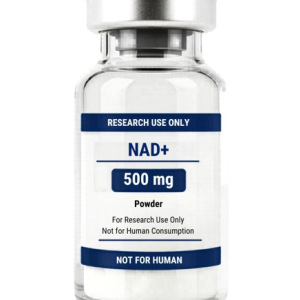
- NAD+. A nucleotide coenzyme whose endogenous levels also fall with age, and likewise a longevity research staple.
- MOTS-c. A mitochondrial-derived peptide, particularly for AMPK and exercise mimetic work, and another compound whose circulating levels decline with age.
Otherwise, browse the full catalog at the Torsena shop.
Reviews
There are no reviews yet.