

Overview
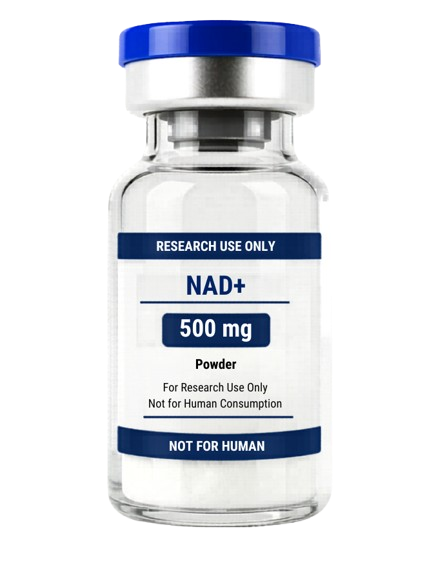
Torsena supplies buffered research-grade NAD+ to qualified laboratories and research institutions across the EU. This product is supplied as lyophilized nicotinamide adenine dinucleotide pre-formulated with sodium bicarbonate buffer. The buffered formulation neutralizes the compound’s natural acidity, producing physiological pH (~7.0-7.4) upon reconstitution. Orders ship from EU-based stock with batch documentation available upon request.
Lot & Supply Format
- Buffered formulation (NAD+ with sodium bicarbonate buffer)
- Lyophilized powder in sealed glass research vials
- Single vials and bulk quantities available
- CoA transparency: batch-specific certificate of analysis available upon request
- Shipped from Europe with temperature-appropriate packaging
What is NAD+ (Buffered)?
This product contains nicotinamide adenine dinucleotide (NAD+) co-lyophilized with sodium bicarbonate buffer. The buffered format reconstitutes directly to physiological pH without requiring additional pH adjustment. This eliminates a common source of variability in research workflows and provides consistent starting conditions across experiments.
NAD+ is a naturally occurring pyridine nucleotide coenzyme. It serves as an essential cofactor in over 500 enzymatic reactions. The compound is central to cellular energy metabolism. It functions as the primary electron carrier in glycolysis, the citric acid cycle, and oxidative phosphorylation.
Beyond redox metabolism, NAD+ is a required substrate for three major enzyme families. These are sirtuins (NAD+-dependent deacylases), PARPs (DNA repair enzymes), and CD38/CD157 (cyclic ADP-ribose synthases).
Why buffered: Pure NAD+ produces an acidic pH (~3.0-4.0) upon reconstitution in water, which can degrade the compound and interfere with sensitive assay conditions. The buffered formulation arrives ready-to-use at physiological pH, reducing preparation steps and improving reconstitution consistency.
Supplied exclusively for in-vitro and ex-vivo research by qualified laboratories. Not intended for human or animal administration.
Buffered vs Unbuffered NAD+ — Why It Matters
NAD+ in its pure form is acidic. Unbuffered preparations require researchers to titrate pH manually before use, introducing variability and additional preparation steps. Buffered NAD+ solves this by co-lyophilizing the compound with sodium bicarbonate, producing consistent physiological pH upon reconstitution.
The buffered format is preferred for:
- Standard enzymatic assays where consistent pH is essential
- Routine cell culture and metabolic studies
- High-throughput workflows where preparation time matters
- Applications where assay-to-assay reproducibility is critical
- Researchers without dedicated pH adjustment infrastructure
Mechanistic Overview
Redox Coenzyme Function
NAD+ accepts hydride ions (H⁻) to form NADH in catabolic reactions. NADH then donates electrons to the mitochondrial electron transport chain for ATP synthesis. The NAD+/NADH ratio is a critical metabolic parameter. It is studied in models of cellular energy status, metabolic flux, and mitochondrial function.
Sirtuin Substrate
The seven mammalian sirtuins (SIRT1-7) require NAD+ as a co-substrate. NAD+ availability is rate-limiting for sirtuin function. This makes it a key variable in research models examining sirtuin-mediated gene regulation, metabolic adaptation, and stress response.
PARP Substrate
PARPs consume NAD+ during poly-ADP-ribosylation reactions in the DNA damage response. Competition between PARPs and sirtuins for the NAD+ pool has been characterized as a regulatory mechanism. It is studied in experimental models of genotoxic stress and cellular energy allocation.
CD38 Substrate
CD38 and CD157 hydrolyze NAD+ to produce cyclic ADP-ribose and nicotinamide. CD38 expression increases with age in experimental models. It has been characterized as a major contributor to age-related NAD+ decline. This makes CD38 a research target in longevity and metabolic aging studies.
Reconstitution & Storage
Lyophilized buffered NAD+ is stable at -20°C for long-term storage. For reconstitution:
- Dissolve in deionized water or low-ionic-strength buffer
- No additional pH adjustment required — reconstitutes to physiological pH (~7.0-7.4)
- Reconstituted NAD+ is sensitive to alkaline conditions and elevated temperatures
- Store at 2-8°C for short-term use, or aliquot and freeze at -20°C for extended storage
- Avoid repeated freeze-thaw cycles to preserve compound integrity
Researchers should follow institutional SOPs for handling lyophilized small-molecule cofactors.
Why Torsena
- Ready-to-Use Formulation — Pre-buffered for direct reconstitution at physiological pH
- Batch Transparency — Certificate of Analysis available upon request
- Consistent Availability — Single vials and bulk quantities maintained in stock
- EU Distribution — Shipped from European fulfillment with tracked courier
- Full Documentation — Batch-specific CoA and MSDS available for institutional procurement
Product Specifications
Chemical Name: Nicotinamide Adenine Dinucleotide (Buffered)
Synonyms: NAD+, β-NAD, DPN, Coenzyme I
CAS Number: 53-84-9
Molecular Formula: C₂₁H₂₇N₇O₁₄P₂
Molecular Weight: 663.43 g/mol
PubChem CID: 925
Formulation: Buffered lyophilized powder (with sodium bicarbonate)
Physical Form: White to off-white lyophilized powder
pH (reconstituted in water): ~7.0-7.4
Intended Use: In-vitro / ex-vivo laboratory research only
Analytical Transparency
All Torsena research materials are tested for identity and composition by HPLC and mass spectrometry analysis. Batch-specific documentation is available upon request for institutional procurement.
- UV-Vis spectrophotometric identity confirmation (characteristic A260 absorption)
- HPLC composition analysis (small-molecule method)
- Appearance and solubility verification
Related Research Compounds
Researchers studying cellular energy metabolism, mitochondrial function, and longevity pathways may also be interested in:
Reviews
There are no reviews yet.