

Overview
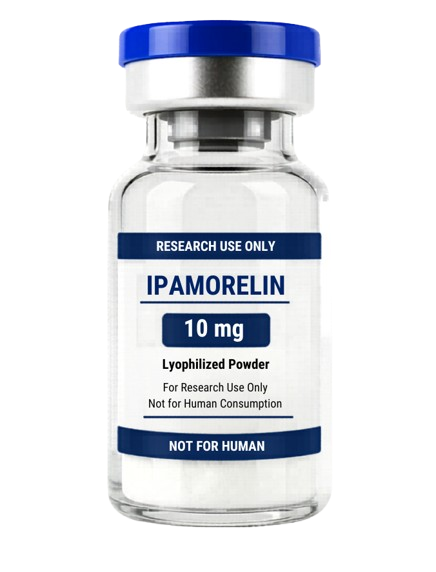
Torsena is a European supplier of research-grade Ipamorelin dedicated to qualified laboratories and research institutions. Orders ship from EU-based stock with batch documentation available upon request. Single vials and bulk quantities are available for ongoing study protocols.
Lot & Supply Format
- Purity ≥99% verified by HPLC/MS analysis
- Mannitol-free formulation (no bulking agents or buffers)
- Lyophilized peptide in sealed glass research vials
- Single vials and bulk quantities available
- CoA transparency: batch-specific certificate of analysis available upon request
- Shipped from Europe with temperature-appropriate packaging
What is Ipamorelin?
Ipamorelin is a synthetic pentapeptide growth hormone secretagogue (GHS). It acts as a selective agonist of the ghrelin/growth hormone secretagogue receptor (GHS-R1a). The compound was developed through iterative structure-activity optimization as a highly selective GHS with minimal off-target receptor activation.
Unlike earlier-generation growth hormone secretagogues such as GHRP-6 and GHRP-2, Ipamorelin has been characterized in receptor binding studies as exhibiting high selectivity for the GHS-R1a. Studies report minimal activation of ACTH, cortisol, or prolactin release pathways in experimental models. This selectivity profile has made Ipamorelin one of the most widely used GHS compounds in growth hormone axis research.
Ipamorelin is frequently studied alongside growth hormone releasing hormone (GHRH) analogs such as CJC-1295. The two compound classes act through complementary receptor systems — GHS-R1a and GHRH receptor respectively. This pairing makes them a common tool combination in pituitary somatotroph signaling research.
Supplied exclusively for in-vitro and ex-vivo research by qualified laboratories. Not intended for human or animal administration.
Mechanistic Overview
GHS-R1a Receptor Activation
Ipamorelin binds the growth hormone secretagogue receptor type 1a (GHS-R1a). This is a G-protein coupled receptor expressed in pituitary somatotroph cells and hypothalamic nuclei in experimental tissue models. Receptor activation has been characterized as stimulating GH release through intracellular calcium mobilization and protein kinase C signaling cascades.
Selectivity Profile
Binding studies have characterized Ipamorelin as exhibiting high selectivity for GHS-R1a. Cross-reactivity at other pituitary hormone pathways is negligible. In contrast to GHRP-6 and hexarelin, Ipamorelin does not significantly stimulate ACTH or cortisol release in experimental models. It also does not activate prolactin secretion pathways at research-relevant concentrations.
Synergy with GHRH Pathway
The GHS-R1a and GHRH receptor represent complementary signaling inputs to pituitary somatotroph function. Published research describes synergistic GH release amplification when GHS and GHRH receptor agonists are administered concurrently in experimental models. This has led to widespread investigation of Ipamorelin in combination with CJC-1295 (Mod GRF 1-29).
Ipamorelin vs GHRP-6
| Characteristic | Ipamorelin | GHRP-6 |
|---|---|---|
| Length | 5 amino acids | 6 amino acids |
| Receptor | GHS-R1a (selective) | GHS-R1a (non-selective) |
| ACTH/Cortisol | Minimal in studies | Elevated in studies |
| Prolactin | Minimal in studies | Elevated in studies |
| Research Focus | Selective GH axis signaling | Broad GHS receptor pharmacology |
| CAS Number | 170851-70-4 | 87616-84-0 |
For paired GH axis research with a GHRH agonist, see also our CJC-1295 + Ipamorelin research blend.
Reconstitution & Storage
Lyophilized Ipamorelin is stable at -20°C for long-term storage. Reconstitution for in-vitro work is typically performed using bacteriostatic water or sterile saline. Reconstituted aliquots are generally stored at 2-8°C for short-term use. For extended storage, aliquot and freeze at -20°C to preserve peptide integrity. Ipamorelin’s small size (5 residues) makes it relatively stable to standard handling, but freeze-thaw cycles should still be minimized. Researchers should follow institutional SOPs for handling lyophilized peptides.
Why Torsena
- Analytical Testing — Purity verified by third-party HPLC and mass spectrometry
- No Fillers — Mannitol-free, no bulking agents or buffer salts
- Batch Transparency — Certificate of Analysis available upon request
- Consistent Availability — Single vials and bulk quantities maintained in stock
- EU Distribution — Shipped from European fulfillment with tracked courier
- Full Documentation — Batch-specific CoA and MSDS available for institutional procurement
Product Specifications
Chemical Name: Ipamorelin
Synonyms: NNC 26-0161
CAS Number: 170851-70-4
Molecular Formula: C₃₈H₄₉N₉O₅
Molecular Weight: 711.85 g/mol
Purity: ≥99% (HPLC/MS)
Physical Form: White lyophilized powder
Additives: None (mannitol-free)
Intended Use: In-vitro / ex-vivo laboratory research only
Amino Acid Sequence
Aib-His-D-2-Nal-D-Phe-Lys-NH₂
Modifications: C-terminal amidation
Aib = α-aminoisobutyric acid, D-2-Nal = D-2-naphthylalanine, D-Phe = D-phenylalanine
Peptide Length: 5 amino acids
Type: Linear, modified
Analytical Transparency
All Torsena research materials are tested for purity and identity by HPLC and mass spectrometry analysis. Batch-specific Certificates of Analysis are available upon request for institutional procurement.
- Reverse-phase HPLC purity determination
- Mass spectrometry identity confirmation
- Appearance and solubility verification
- Endotoxin screening (where applicable)
Related Research Compounds
Researchers studying growth hormone axis signaling, somatotroph receptor pharmacology, and metabolic pathways may also be interested in:
- CJC-1295 + Ipamorelin Blend — co-lyophilized GHRH-R + GHS-R1a research blend
- Retatrutide — triple GLP-1 / GIP / glucagon receptor agonist for metabolic research
- Tirzepatide — dual GLP-1 / GIP receptor agonist for metabolic research
Reviews
There are no reviews yet.