
Overview
Torsena supplies tesamorelin research peptide to qualified laboratories across the European Union. Furthermore, we hold stock in Europe, so orders ship without intra-EU customs delay. Batch documentation is available on request.
Lot & Supply Format
- Purity. Typically ≥99%, and a batch-specific CoA is available on request.
- Formulation. No unnecessary bulking agents or buffer salts.
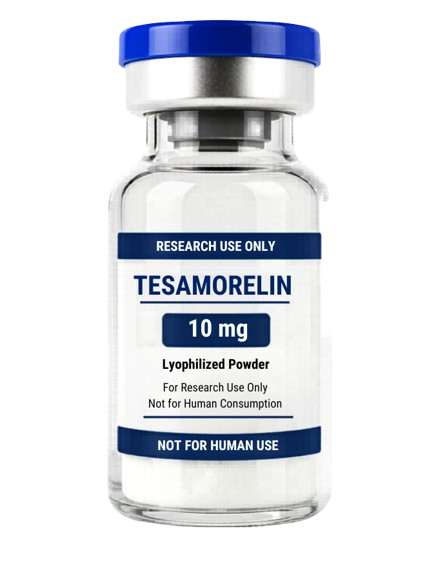
- Presentation. Lyophilized peptide, sealed in glass research vials.
- Quantities. Single vials as standard, though we also quote small bulk on request.
- Shipping. Dispatched from Europe, and always with temperature-appropriate packaging.
What is Tesamorelin?
Tesamorelin is a synthetic 44-amino-acid analog of human growth hormone-releasing hormone. It carries a trans-3-hexenoyl group on the N-terminal tyrosine, and that single modification is what separates it from the native hormone.
Native GHRH survives only a few minutes in circulation, because dipeptidyl peptidase-4 cleaves it at the position-2 alanine almost immediately. The N-terminal acylation in tesamorelin obstructs that site. Consequently the peptide retains activity long enough to be practical in protocols requiring sustained receptor engagement, which is the basis of most research interest in the compound.
Tesamorelin acts at the GHRH receptor rather than the ghrelin receptor, so it sits mechanistically apart from growth hormone secretagogues targeting GHS-R1a. Researchers use it in work on somatotroph signaling, endogenous growth hormone pulsatility, and downstream IGF-1 dynamics.
Supplied exclusively for in-vitro and ex-vivo research by qualified laboratories. Not intended for human or animal administration.
Mechanistic Overview
GHRH receptor engagement. Tesamorelin binds the GHRH receptor on anterior pituitary somatotrophs, a class B G-protein coupled receptor. Studies examine cAMP-mediated signal transduction, somatotroph transcriptional response, and stimulated release of stored growth hormone.
Preserved pulsatility. Because the compound acts upstream at the pituitary rather than supplying growth hormone directly, models using it retain the physiological negative feedback loop involving IGF-1 and somatostatin. Therefore it differs fundamentally from experimental designs using exogenous growth hormone, where that feedback architecture is bypassed entirely. This distinction is the main reason the compound appears in endocrine signaling research.
DPP-4 resistance. The trans-3-hexenoyl group prevents DPP-4 from reaching the position-2 cleavage site. Consequently the activity window extends substantially relative to native GHRH(1-44), which is otherwise degraded within minutes.
Downstream IGF-1 axis. Stimulated growth hormone release drives hepatic IGF-1 production. Research using GHRH analogs has examined this axis in the context of lipid metabolism, hepatic substrate handling, and tissue-level growth signaling.
Two Solutions to the Same Problem
DPP-4 cleaves GHRH at the position-2 alanine, and both of the GHRH analogs in common research use are built specifically to prevent that. However, they do it by different routes.
| Tesamorelin | Modified GRF (1-29) | |
|---|---|---|
| Strategy | Block access to the site | Change the residue itself |
| Modification | N-terminal trans-3-hexenoyl acylation | D-Ala substitution at position 2 |
| Sequence retained | Full GHRH(1-44), unaltered | GHRH(1-29), four substitutions |
| Length | 44 residues | 29 residues |
| Molecular weight | 5135.9 Da | ~3368 Da |
The difference matters for experimental design. Tesamorelin keeps the native GHRH sequence intact and defends it externally, whereas Modified GRF alters the sequence itself at four positions. Therefore a protocol testing sequence-dependent receptor behaviour may not treat the two as interchangeable GHRH analogs.
Published Research Data
Tesamorelin has been through controlled clinical trials, primarily in HIV-associated lipodystrophy, and it holds regulatory approval in some jurisdictions under the trade name Egrifta. Subsequent work has examined hepatic fat content and related metabolic endpoints. However, protocols vary, so consult the primary sources before designing your own work.
Key references:
Falutz J, et al. Metabolic effects of a growth hormone-releasing factor in patients with HIV. N Engl J Med. 2007;357(23):2359-2370.
Stanley TL, et al. Effects of tesamorelin on non-alcoholic fatty liver disease in HIV: a randomised, double-blind, multicentre trial. Lancet HIV. 2019;6(12):e821-e830.
Tesamorelin vs Other Growth Hormone Axis Compounds
| Characteristic | Tesamorelin | CJC-1295 no DAC | Ipamorelin |
|---|---|---|---|
| Receptor target | GHRH receptor | GHRH receptor | GHS-R1a, ghrelin receptor |
| Peptide class | GHRH analog | GHRH analog | Growth hormone secretagogue |
| Second messenger | cAMP, PKA | cAMP, PKA | Ca²⁺, PKC |
| Length | 44 amino acids | 29 amino acids | 5 amino acids |
| Molecular weight | 5135.9 Da | ~3368 Da | 711.85 Da |
| DPP-4 defence | N-terminal acylation | D-Ala2 substitution | Non-standard residues throughout |
| Contains sulfur | Yes, one methionine | No | No |
| CAS number | 218949-48-5 | 863288-34-0 | 170851-70-4 |
Tesamorelin research peptide specifications
| Chemical name | Tesamorelin |
| Synonyms | TH9507, trans-3-hexenoyl-GHRH(1-44) |
| CAS number | 218949-48-5 |
| Molecular formula | C221H366N72O67S |
| Molecular weight | 5135.9 g/mol |
| Peptide length | 44 amino acids |
| Backbone | Human GHRH(1-44), unaltered |
| N-terminal modification | trans-3-hexenoyl on Tyr1 |
| C-terminus | Amidated |
| Sulfur source | Methionine at position 27 |
| Typical purity | ≥99% (HPLC / MS) |
| Physical form | White to off-white lyophilized powder |
| Available sizes | 10mg |
| Storage | -20°C, sealed, protected from light and air |
| Intended use | In-vitro / ex-vivo laboratory research only |
Note that the formula and the molecular weight corroborate each other: C221H366N72O67S sums to 5135.85, so a CoA reporting a mass materially away from that figure warrants a question.
Amino Acid Sequence
Tyr*-Ala-Asp-Ala-Ile-Phe-Thr-Asn-Ser-Tyr-Arg-Lys-Val-Leu-Gly-Gln-Leu-Ser-Ala-Arg-Lys-Leu-Leu-Gln-Asp-Ile-Met-Ser-Arg-Gln-Gln-Gly-Glu-Ser-Asn-Gln-Glu-Arg-Gly-Ala-Arg-Ala-Arg-Leu
Modifications:
*Tyr1 N-terminally acylated with trans-3-hexenoic acid
C-terminal amide
Backbone: Human GHRH(1-44) sequence
Type: Linear, N-terminally acylated
Note: Methionine sits at position 27, and it is the only sulfur-containing residue.
Reconstitution & Storage
The methionine at position 27 gives tesamorelin a handling requirement that most peptides in our range do not have. Methionine oxidises to methionine sulfoxide on air exposure, and that is the principal degradation route for this compound.
- Air exposure. Minimise headspace and open-vial time, since oxidation is the main risk.
- Inert atmosphere. Store under nitrogen or argon where your lab has the capability.
- Solvent. Sterile water or a suitable aqueous buffer.
- Short-term storage. 2-8°C for reconstituted aliquots.
- Long-term storage. Aliquot, then freeze at -20°C.
- Freeze-thaw. Avoid repeated cycles, particularly given the peptide’s length.
Keep lyophilized material at -20°C and protect it from light. Furthermore, let vials warm to room temperature before opening, because condensation otherwise pulls moisture into the powder. Otherwise follow your institutional SOPs.
Analytical Documentation
Batch-specific Certificates of Analysis are available on request for institutional procurement. Typically the documentation covers three areas.
- Purity. Determined by reverse-phase HPLC.
- Identity. Confirmed by mass spectrometry.
- Physical checks. Namely appearance and solubility verification.
Note that methionine-containing peptides show a plus sixteen mass shift when oxidised, since that is the mass of the added oxygen. Therefore mass spectrometry data is worth reading closely on this compound specifically.
Why Choose Torsena for Tesamorelin Research Peptide
- Documentation. We send batch CoAs on request, and they cover both HPLC purity and MS identity.
- Clean formulation. No unnecessary bulking agents or buffer salts.
- EU distribution. We ship from European stock, and therefore intra-EU orders clear no customs.
- Direct contact. You reach the team directly, rather than a ticket queue.
Frequently Asked Questions
What is the molecular formula of tesamorelin?
C221H366N72O67S, with a molecular weight of 5135.9 g/mol. The single sulfur comes from the methionine at position 27. Those atoms sum to 5135.85, so the formula and the stated mass corroborate one another.
How does tesamorelin resist DPP-4?
Dipeptidyl peptidase-4 cleaves native GHRH at the position-2 alanine within minutes. Tesamorelin carries a trans-3-hexenoyl group on the N-terminal tyrosine, and that group obstructs access to the cleavage site. Notably the underlying sequence is unaltered, so the defence is external rather than structural.
How does tesamorelin differ from Modified GRF (1-29)?
Both are GHRH analogs defending against the same enzyme, but by opposite strategies. Tesamorelin keeps the full 44-residue GHRH sequence intact and blocks DPP-4 access with an N-terminal acyl group. Modified GRF truncates to 29 residues and substitutes the position-2 alanine for its D-enantiomer so the enzyme no longer recognises it. Consequently protocols testing sequence-dependent receptor behaviour should not treat them as interchangeable.
Why does tesamorelin need special storage?
Because of the methionine at position 27. Methionine oxidises to methionine sulfoxide on air exposure, and that is the main degradation route here. Therefore minimise headspace and open time, and store under inert atmosphere where possible. Oxidation appears in mass spectrometry as a plus sixteen mass shift.
What is the regulatory status of tesamorelin?
It holds approval in some jurisdictions under the trade name Egrifta, indicated for HIV-associated lipodystrophy. Material supplied by Torsena is for in-vitro and ex-vivo laboratory research only, never for human or animal administration.
Related Research Compounds
Researchers working on the growth hormone axis and hepatic metabolism usually look at these as well.
- Retatrutide. A triple receptor agonist, and therefore relevant where hepatic lipid metabolism is the shared endpoint.
- CJC-1295 + Ipamorelin. The other GHRH analog in our range, paired with a GHS-R1a agonist, namely for work comparing the two DPP-4 defence strategies.
- NAD+ Buffered. A cofactor central to cellular metabolism research.
Otherwise, browse the full catalog at the Torsena shop.