

Overview
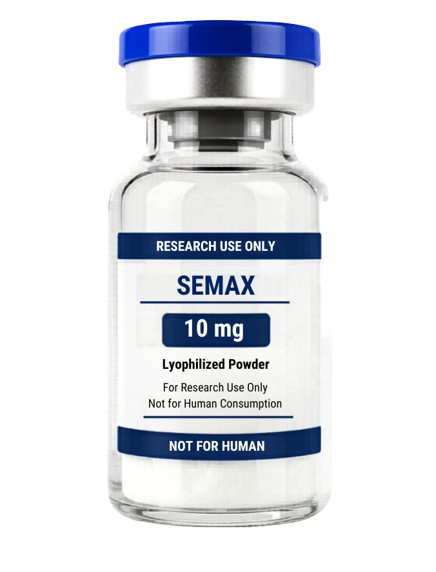
Torsena supplies research-grade Semax to qualified laboratories across the European Union. Furthermore, we hold stock in Europe, so orders ship without intra-EU customs delay. Batch documentation is available on request.
Lot & Supply Format
- Purity. Typically ≥99%, and a batch-specific CoA is available on request.
- Formulation. Mannitol-free, so no bulking agents or buffer salts dilute the material.
- Presentation. Lyophilized powder, sealed in glass research vials.
- Quantities. Single vials as standard, though we also quote bulk on request.
- Shipping. Dispatched from Europe, and always with temperature-appropriate packaging.
What is Semax?
Semax is a synthetic heptapeptide with the sequence Met-Glu-His-Phe-Pro-Gly-Pro. The first four residues come from adrenocorticotropic hormone, while the Pro-Gly-Pro tail is a synthetic addition that supplies resistance to peptidase degradation.
Crucially, the native ACTH fragment retains neurotropic activity without the adrenocorticotropic effects of the full-length hormone. Therefore Semax served as a tool for separating those two properties, which is why the Institute of Molecular Genetics of the Russian Academy of Sciences pursued it. Ashmarin and colleagues began that work in the 1980s.
On the ACTH numbering. You will see Semax described as both an ACTH(4-7) and an ACTH(4-10) analog, and the inconsistency confuses buyers constantly. Both are defensible. The formal chemical designation is (Pro8, Gly9, Pro10)-ACTH(4-10), meaning the peptide spans ACTH positions 4 through 10 but substitutes Pro-Gly-Pro for the native Arg-Trp-Gly at positions 8 to 10. Consequently “ACTH(4-7) plus Pro-Gly-Pro” describes the construction, whereas “ACTH(4-10) analog” describes what it is an analog of. Sigma-Aldrich uses both phrases in a single product listing.
Supplied exclusively for in-vitro and ex-vivo research by qualified laboratories. Not intended for human or animal administration.
Mechanistic Overview
Neurotrophin signaling. This is the most consistently reported mechanism in the literature. Dolotov and colleagues reported in 2006 that a single 50 µg/kg dose produced roughly a threefold rise in BDNF exon III mRNA and a 1.4-fold rise in BDNF protein in rat hippocampus. Moreover, the same work described regulation of the TrkB receptor alongside BDNF itself. Therefore studies typically treat the BDNF/TrkB axis as the primary readout.
Monoaminergic systems. Work published in Neurochemical Research examined dopaminergic and serotonergic parameters after intraperitoneal dosing at 0.15 mg/kg. Striatal 5-HIAA rose about 25% at two hours, and extracellular striatal 5-HIAA climbed to roughly 180% over one to four hours. However, and this matters for experimental design, Semax alone did not alter dopamine or its metabolites. Instead it sharply amplified the dopaminergic response to d-amphetamine given twenty minutes later. Consequently a Semax-only condition may show nothing on dopamine endpoints while a co-administration design shows a large effect.
Melanocortin receptor interaction. Because the parent sequence is an ACTH fragment, research has examined binding across melanocortin receptor subtypes in CNS tissue, particularly MC3R and MC4R, alongside downstream neuroplasticity signaling.
Enkephalin metabolism. Kost and colleagues reported in 2001 that Semax and Selank both inhibit enkephalin-degrading enzymes in human serum. Therefore researchers frequently run the two compounds in parallel on this endpoint.
Research Applications
- BDNF and NGF expression. mRNA and protein endpoints, and likewise downstream TrkB and TrkA signaling.
- Neuroprotection models. Oxidative stress, excitotoxicity, and ischemia-reperfusion protocols.
- Monoaminergic research. Serotonin turnover primarily, though see the dopamine caveat above.
- Learning and memory paradigms. Rodent behavioural work, particularly attention and consolidation tasks.
- Enkephalin turnover. Serum enzyme activity assays, namely carboxypeptidase and aminopeptidase.
Published rodent protocols commonly dose between 50 µg/kg and 0.15 mg/kg intraperitoneally. However, dosing varies by endpoint, so consult the primary sources before designing your own work.
Published Research Data
Key references:
Kost NV, et al. Semax and Selank inhibit the enkephalin-degrading enzymes of human serum. Bull Exp Biol Med. 2001.
Eremin KO, et al. Semax, an ACTH(4-10) analogue with nootropic properties, activates dopaminergic and serotoninergic brain systems in rodents. Neurochem Res. 2005.
Dolotov OV, et al. Semax, an analogue of ACTH(4-10) with cognitive effects, regulates BDNF and trkB expression in the rat hippocampus. Brain Res. 2006.
Semax vs Selank
Both peptides came out of the same institute, and both carry the same Pro-Gly-Pro stabilising tail. Otherwise they have little in common.
| Characteristic | Semax | Selank |
|---|---|---|
| Parent sequence | ACTH(4-10), positions 8-10 substituted | Tuftsin, Thr-Lys-Pro-Arg |
| Parent origin | Adrenocorticotropic hormone | IgG Fc domain |
| Sequence | MEHFPGP | TKPRPGP |
| Stabilising motif | Pro-Gly-Pro, C-terminal | Pro-Gly-Pro, C-terminal |
| Primary research target | BDNF, TrkB, monoaminergic | GABAergic, enkephalin, cytokine |
| Phenotype studied | Cognitive, nootropic-like | Anxiolytic-like |
| Contains sulfur | Yes, one methionine | No |
| Molecular weight | 813.93 Da | 751.87 Da |
| CAS number | 80714-61-0 | 129954-34-3 |
Notably the enkephalin enzyme finding applies to both, since Kost and colleagues tested them together. Therefore the two compounds pair naturally in that context.
Semax research peptide specifications
| Chemical name | Semax |
| Formal designation | (Pro8, Gly9, Pro10)-ACTH(4-10) |
| Synonyms | ACTH(4-7) Pro-Gly-Pro, Semax heptapeptide |
| CAS number | 80714-61-0 |
| Molecular formula | C37H51N9O10S |
| Molecular weight | 813.93 g/mol |
| Sequence | Met-Glu-His-Phe-Pro-Gly-Pro |
| One-letter code | MEHFPGP |
| Native fragment | Met-Glu-His-Phe, ACTH positions 4-7 |
| Extension | Pro-Gly-Pro, C-terminal |
| Peptide length | 7 amino acids |
| Type | Linear, unmodified |
| Typical purity | ≥99% (HPLC / MS) |
| Physical form | White lyophilized powder |
| Additives | None, mannitol-free |
| Storage | -20°C, sealed, protected from light and air |
| Intended use | In-vitro / ex-vivo laboratory research only |
Reconstitution & Storage
Semax carries one methionine residue, and that single sulfur atom dictates how the compound should be handled. Methionine oxidises to methionine sulfoxide on exposure to air, which is the principal degradation route for Met-containing peptides. Therefore Semax needs slightly more care than the rest of our range.
- Air exposure. Minimise headspace and time open, since oxidation is the main risk here.
- Inert atmosphere. Store under nitrogen or argon where your lab has the capability.
- Solvent. Sterile water or a suitable aqueous buffer.
- Short-term storage. 2-8°C for reconstituted aliquots.
- Long-term storage. Aliquot, then freeze at -20°C.
- Freeze-thaw. Avoid repeated cycles, because each one costs integrity.
Keep lyophilized material at -20°C and protect it from light. Furthermore, let vials warm to room temperature before opening, because condensation otherwise pulls moisture into the powder. Otherwise follow your institutional SOPs.
Analytical Documentation
We provide batch-specific Certificates of Analysis on request. Typically the documentation covers three areas.
- Purity. Determined by reverse-phase HPLC.
- Identity. Confirmed by mass spectrometry.
- Physical checks. Namely appearance and solubility verification.
Note that methionine-containing peptides can show a mass shift of plus sixteen if oxidation has occurred, since that is the mass of the added oxygen. Therefore mass spectrometry data is worth reading carefully on this particular compound.
Why Choose Torsena for Semax
- Documentation. We send batch CoAs on request, and they cover both HPLC purity and MS identity.
- No fillers. Mannitol-free, so nothing dilutes the material you paid for.
- EU distribution. We ship from European stock, and therefore intra-EU orders clear no customs.
- Direct contact. You reach the team directly, rather than a ticket queue.
Frequently Asked Questions
What is the molecular formula of Semax?
Semax is C37H51N9O10S with a molecular weight of 813.93 g/mol. The sulfur comes from the single methionine residue at the N-terminus. Note that formulas omitting the S appear on some vendor sites, and they are wrong, since a methionine-containing peptide must carry a sulfur atom.
Is Semax an ACTH(4-7) or an ACTH(4-10) analog?
Both descriptions appear in the literature and both are defensible. The formal designation is (Pro8, Gly9, Pro10)-ACTH(4-10), so the peptide spans ACTH positions 4 to 10 while substituting Pro-Gly-Pro for the native Arg-Trp-Gly at 8 to 10. Therefore “ACTH(4-7) plus Pro-Gly-Pro” describes how it is built, whereas “ACTH(4-10) analog” describes what it derives from.
Why does Semax need special storage?
Because of the methionine. Methionine oxidises to methionine sulfoxide on air exposure, and that is the main degradation pathway for this compound. Consequently you should minimise headspace and open time, and store under inert atmosphere where possible. Oxidation shows up in mass spectrometry as a plus sixteen mass shift.
What is the difference between Semax and Selank?
Both are heptapeptides from the same Russian institute carrying the same Pro-Gly-Pro tail, but their parent sequences are unrelated. Semax derives from ACTH and features in BDNF and cognitive research. Selank derives from tuftsin, an immunopeptide, and features in GABAergic and anxiolytic research. However, the enkephalin enzyme findings apply to both.
Is Semax approved for clinical use?
Only in Russia, where it has been registered since 2011. It holds no marketing authorisation in the EU, the UK, or the US. Torsena supplies it strictly for in-vitro and ex-vivo laboratory research, never for human or animal administration.
Related Research Compounds
Researchers working on Semax almost always look at its sibling compound too.
- Selank. The tuftsin analog from the same institute, and therefore the natural paired comparison, particularly since the enkephalin enzyme findings cover both.
Otherwise, browse the full catalog at the Torsena shop.
Reviews
There are no reviews yet.