

Overview
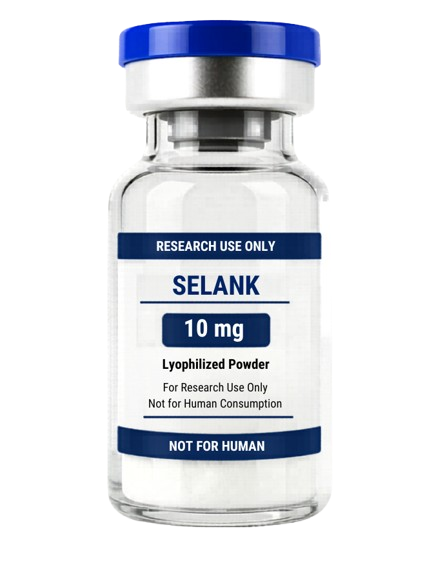
Torsena supplies research-grade Selank to qualified laboratories across the European Union. Furthermore, we hold stock in Europe, so orders ship without intra-EU customs delay. Batch documentation is available on request.
Lot & Supply Format
- Purity. Typically ≥99%, and a batch-specific CoA is available on request.
- Formulation. Mannitol-free, so no bulking agents or buffer salts dilute the material.
- Presentation. Lyophilized powder, sealed in glass research vials.
- Quantities. Single vials as standard, though we also quote bulk on request.
- Shipping. Dispatched from Europe, and always with temperature-appropriate packaging.
What is Selank?
Selank is a synthetic heptapeptide built on tuftsin, an endogenous immunomodulatory tetrapeptide. Specifically, the tuftsin core Thr-Lys-Pro-Arg carries a C-terminal Pro-Gly-Pro extension, and that extension supplies metabolic stability the parent peptide lacks.
Tuftsin itself comes from the Fc domain of immunoglobulin G. Najjar and Nishioka first characterised it in 1970 as a phagocytosis-stimulating peptide, so its origins sit firmly in immunology rather than neuroscience. Consequently Selank occupies unusual ground: an immunopeptide scaffold studied primarily for central nervous system effects.
The Institute of Molecular Genetics of the Russian Academy of Sciences developed both Selank and Semax, working with the Zakusov Research Institute of Pharmacology. Notably both peptides use the same Pro-Gly-Pro stabilisation strategy, yet they are built on entirely unrelated parent sequences. Therefore they serve different research purposes despite the shared design logic.
Supplied exclusively for in-vitro and ex-vivo research by qualified laboratories. Not intended for human or animal administration.
Important Note on Experimental Model Choice
Two studies from the same research group reached apparently contradictory results, and the difference comes down entirely to the model used. Anyone planning work with Selank should understand this before designing a protocol.
In 2016, Volkova and colleagues dosed rats at 300 μg/kg and measured 84 neurotransmission-related genes in frontal cortex. Consequently they found 45 genes altered at one hour and 22 at three hours, with changes correlating positively with those produced by GABA itself.
However, the 2017 follow-up used cultured IMR-32 neuroblastoma cells and found no direct change in GABAergic gene expression from Selank alone. Instead Selank modified what GABA did, largely suppressing GABA-induced expression changes when the two were combined.
Therefore the two results are consistent rather than contradictory. The reasonable reading is that Selank acts by allosteric modulation, so it needs an existing GABA signal to modulate. In an isolated cell line without that signal, there is nothing for it to act on. Researchers designing in-vitro work should account for this, since a Selank-only condition in a cell line may well produce no measurable effect.
Mechanistic Overview
GABAergic allosteric modulation. Radioligand-receptor work published in 2018 by Vyunova and colleagues characterises Selank as a positive allosteric modulator of GABA binding. Importantly, this differs from benzodiazepine action: benzodiazepines bind the receptor directly, whereas Selank appears to increase receptor sensitivity to endogenous GABA. Consequently it serves as a reference compound in work on peptidergic modulation of inhibitory neurotransmission.
Enkephalin metabolism. Kost and colleagues reported in 2001 that both Selank and Semax inhibit enkephalin-degrading enzymes in human serum. Specifically the described targets are carboxypeptidase and aminopeptidase pathways. Because inhibiting degradation extends endogenous enkephalin signaling, this positions Selank as a tool for probing opioid peptide turnover.
Neuroimmune signaling. Given the tuftsin origin, published work also reports effects on cytokine signaling, including interleukin expression. Therefore studies use Selank at the interface between immune signaling and CNS function, an area usually described as neuroimmune or psychoneuroimmunological research.
Research Applications
- Anxiety and stress models. Rodent behavioural work, and notably a 2017 study reporting enhancement of diazepam effects under chronic mild stress.
- GABAergic gene expression. In-vivo studies, though see the model-choice note above before designing cell-line work.
- Enkephalin turnover. Serum enzyme activity assays, particularly carboxypeptidase and aminopeptidase.
- BDNF research. A 2019 rat study reported effects on hippocampal and prefrontal cortex BDNF content.
- Neuroimmune signaling. Cytokine measurements, and likewise peripheral immune tissue models.
Published rodent work commonly dose around 300 μg/kg. However, dosing varies with model and endpoint, so consult the primary sources directly.
Published Research Data
Key references:
Najjar VA, Nishioka K. Tuftsin: a natural phagocytosis stimulating peptide. Nature. 1970;228(5272):672-673.
Kost NV, et al. Semax and Selank inhibit the enkephalin-degrading enzymes of human serum. Bull Exp Biol Med. 2001.
Volkova A, Shadrina M, Kolomin T, et al. Selank administration affects the expression of some genes involved in GABAergic neurotransmission. Front Pharmacol. 2016;7:31.
Kolomin T, Shadrina M, et al. GABA, Selank, and olanzapine affect the expression of genes involved in GABAergic neurotransmission in IMR-32 cells. Front Pharmacol. 2017;8:89.
Vyunova TV, Andreeva L, et al. Peptide regulation of GABA-benzodiazepine receptor. Protein Pept Lett. 2018.
Selank vs Semax
Both peptides came out of the same institute, and both use the same stabilising motif. Otherwise they have little in common.
| Characteristic | Selank | Semax |
|---|---|---|
| Parent peptide | Tuftsin, an immunopeptide | ACTH(4-10), a neuropeptide |
| Parent origin | IgG Fc domain | Adrenocorticotropic hormone |
| Stabilising motif | Pro-Gly-Pro, C-terminal | Pro-Gly-Pro, C-terminal |
| Primary research target | GABAergic, enkephalin, cytokine | BDNF, dopaminergic, cholinergic |
| Phenotype studied | Anxiolytic-like | Cognitive, nootropic-like |
| Length | 7 amino acids | 7 amino acids |
| Molecular weight | 751.87 Da | 813.93 Da |
| CAS number | 129954-34-3 | 80714-61-0 |
Notably the enkephalin finding applies to both, since Kost and colleagues tested them together. Therefore researchers often run the two in parallel.
Selank research peptide specifications
| Chemical name | Selank |
| Synonyms | TP-7, Selanc |
| CAS number | 129954-34-3 |
| Molecular formula | C33H57N11O9 |
| Molecular weight | 751.87 g/mol |
| Sequence | Thr-Lys-Pro-Arg-Pro-Gly-Pro |
| One-letter code | TKPRPGP |
| Parent sequence | Tuftsin, Thr-Lys-Pro-Arg |
| Extension | Pro-Gly-Pro, C-terminal |
| Peptide length | 7 amino acids |
| Type | Linear, unmodified |
| Typical purity | ≥99% (HPLC / MS) |
| Physical form | White lyophilized powder |
| Additives | None, mannitol-free |
| Storage | -20°C, sealed, protected from light |
| Intended use | In-vitro / ex-vivo laboratory research only |
Because the sequence is short and proline-rich, the theoretical mass is unambiguous. Therefore mass spectrometry confirms identity cleanly, which makes Selank one of the easier peptides to verify against a CoA.
Reconstitution & Storage
Selank contains threonine, lysine and arginine, so it is polar and dissolves readily in aqueous solution.
- Solvent. Sterile water or a suitable aqueous buffer.
- Short-term storage. 2-8°C for reconstituted aliquots.
- Long-term storage. Aliquot, then freeze at -20°C.
- Freeze-thaw. Avoid repeated cycles, since each one costs integrity.
Keep lyophilized material at -20°C and protect it from light. Furthermore, let vials warm to room temperature before opening, because condensation otherwise pulls moisture into the powder. Otherwise follow your institutional SOPs for peptide handling.
Analytical Documentation
We provide batch-specific Certificates of Analysis on request. Typically the documentation covers three areas.
- Purity. Determined by reverse-phase HPLC.
- Identity. Confirmed by mass spectrometry.
- Physical checks. Namely appearance and solubility verification.
Why Choose Torsena for Selank
- Documentation. We send batch CoAs on request, and they cover both HPLC purity and MS identity.
- No fillers. Mannitol-free, so nothing dilutes the material you paid for.
- EU distribution. We ship from European stock, and therefore intra-EU orders clear no customs.
- Direct contact. You reach the team directly, rather than a ticket queue.
Frequently Asked Questions
What is the molecular weight of Selank?
Selank weighs 751.87 g/mol, and its formula is C33H57N11O9. The sequence is Thr-Lys-Pro-Arg-Pro-Gly-Pro, and because it is short and unmodified the theoretical mass is unambiguous. Therefore mass spectrometry verifies identity cleanly.
What is the difference between Selank and Semax?
Both are heptapeptides from the same Russian institute, and both carry the same Pro-Gly-Pro stabilising extension. However, their parent sequences are unrelated. Selank builds on tuftsin, an immunopeptide from IgG, whereas Semax builds on ACTH(4-10). Consequently Selank features in GABAergic and anxiolytic research while Semax features in BDNF and cognitive research.
Does Selank work in cell culture?
Not straightforwardly. A 2017 study in IMR-32 neuroblastoma cells found no direct change in GABAergic gene expression from Selank alone, though it did modify GABA-induced changes. Because Selank appears to act by allosteric modulation, it needs an existing GABA signal to act on. Therefore a Selank-only condition in an isolated cell line may produce no measurable effect, and protocols should account for that.
How does Selank differ from a benzodiazepine mechanistically?
Benzodiazepines bind the GABA-A receptor directly. Selank, by contrast, is characterised as a positive allosteric modulator that increases receptor sensitivity to endogenous GABA rather than substituting for it. Radioligand work published in 2018 supports this distinction.
Is Selank approved for clinical use?
Not outside Russia, where it is registered. It holds no marketing authorisation in the EU, the UK, or the US. Torsena supplies it strictly for in-vitro and ex-vivo laboratory research, never for human or animal administration.
Related Research Compounds
Researchers working on Selank almost always look at its sibling compound too.
- Semax. The ACTH(4-10) analog from the same institute, and therefore the natural paired comparison, particularly since the enkephalin enzyme findings cover both.
Otherwise, browse the full catalog at the Torsena shop.
Reviews
There are no reviews yet.